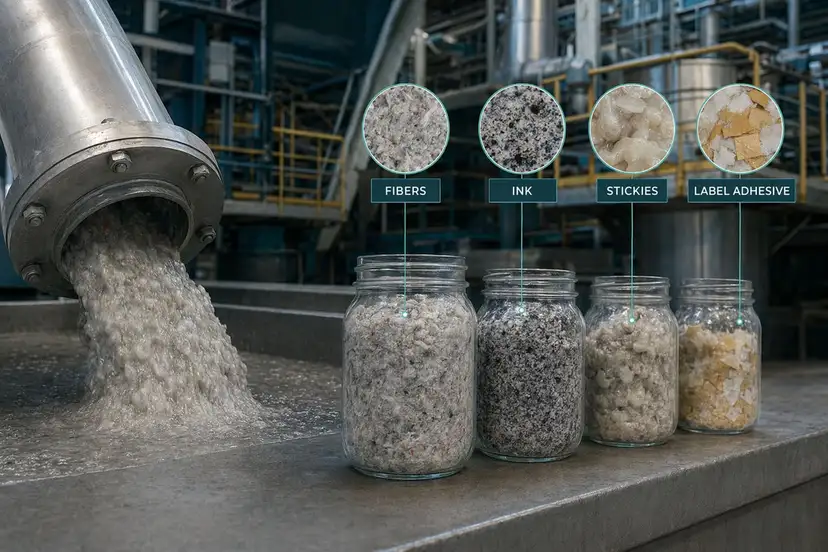
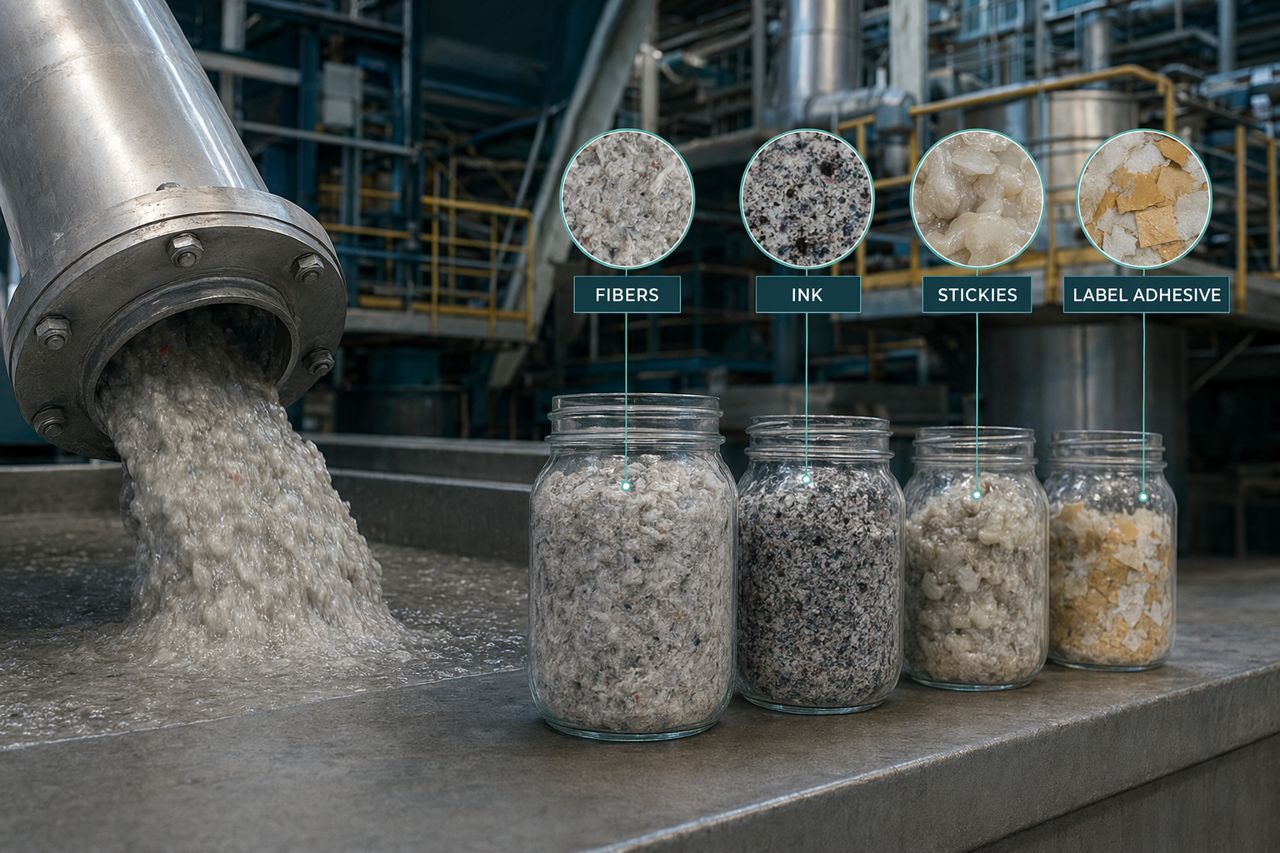
Stickies, Hot-Melt Adhesives, Labels, and Tape: A Mill Manager’s Guide to Recycled Paper Contaminants
Recovered fiber gives a paper recycling mill economic flexibility, but it also brings a moving target of adhesives, coatings, inks, binders, labels, laminates, and packaging residues. When those contaminants are not controlled early, they do not stay in one place. They move through pulping, screening, cleaning, flotation, thickening, storage, approach flow, and the paper machine.
For a pulping manager, the issue is not academic. Stickies show up as deposits, sheet defects, plugged baskets, unstable drainage, higher chemical demand, lost fiber, wash-ups, and unplanned downtime.
Pulprift works with mills that need cleaner recovered fiber systems without adding unnecessary chemical load. As an enzyme supplier for paper deinking mills, Pulprift focuses on practical application windows, contaminant behavior, and measurable process outcomes: brightness support, stickies reduction, drainage improvement, and better operating stability.
Why stickies are harder to manage than ordinary dirt
Sand, grit, glass, and metal behave like high-density contaminants. They can often be removed by cleaning systems because their physical behavior is predictable.
Stickies are different.
They soften, smear, deform, fragment, agglomerate, and redeposit depending on temperature, shear, pH, furnish mix, water chemistry, and residence time. A contaminant that enters as a label adhesive can become a dispersed tacky particle after pulping, a deposit on a screen basket, a speck in flotation reject, or a sheet defect on the machine.
Primary stickies versus secondary stickies
Primary stickies enter the mill as visible adhesive or polymeric particles. These may come from:
- Pressure-sensitive labels
- Hot-melt glue from cartons and packaging
- Tape adhesives
- Bookbinding glue
- Envelope adhesives
- Laminated packaging residues
- Waxed or coated paper grades
- Synthetic binders in coated recovered paper
Secondary stickies form inside the system when dissolved and colloidal materials destabilize. They can be triggered by:
- Changes in pH or conductivity
- Calcium hardness
- Cationic chemical overdosing
- Temperature swings
- High closure of white water loops
- Mechanical shear during pulping, pumping, or screening
A mill may remove visible contaminants well and still suffer from secondary stickies later in the process.
The mill-floor cost of adhesive contamination
Stickies are not just a quality issue. They affect the operating economics of the entire recycled fiber line.
1. Screening load increases
Adhesives can blind or plug coarse and fine screens. As slot openings load with tacky material, pressure differential rises and throughput stability drops. Operators may compensate with higher dilution, more frequent cleaning, or reduced feed rate.
The result is predictable: more energy, more rejects handling, and less pulper-to-machine consistency.
2. Deinking performance becomes less stable
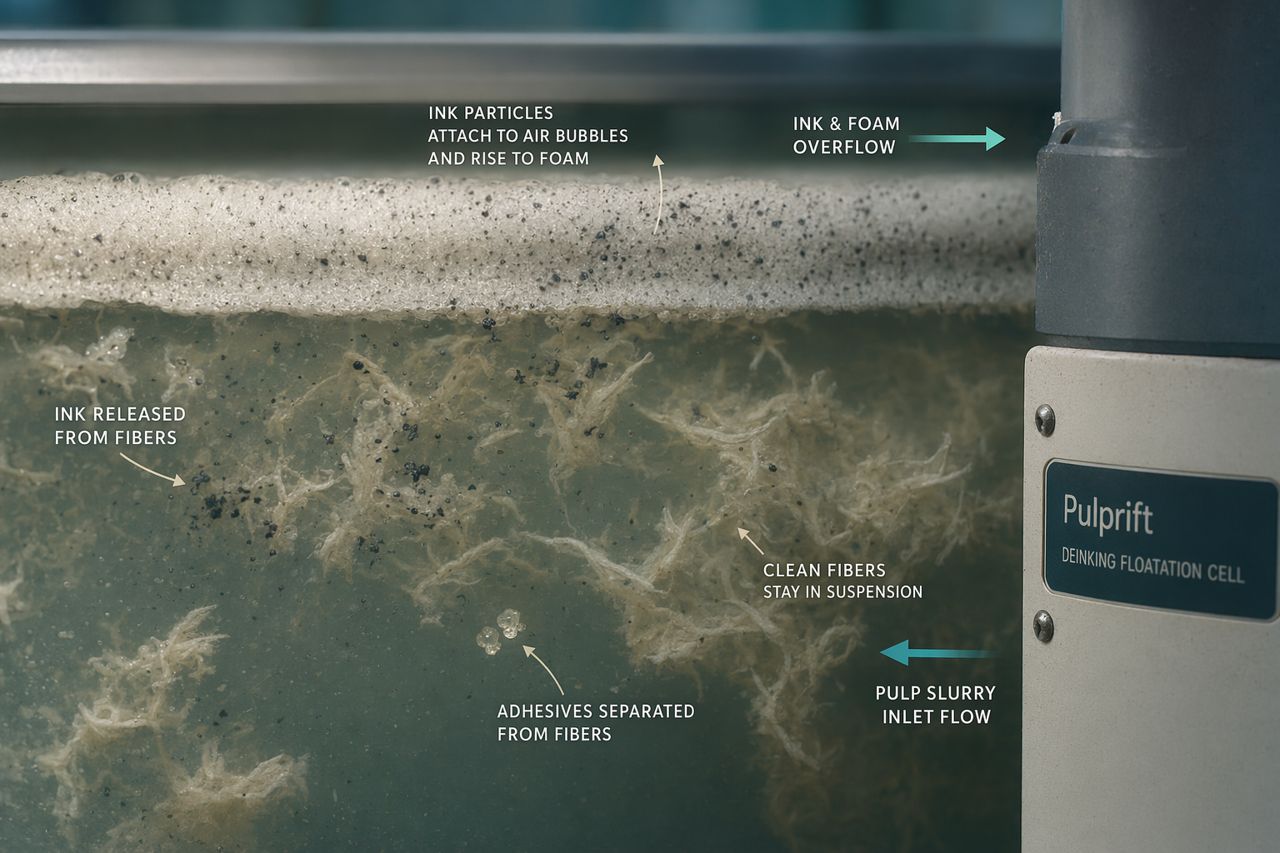
In deinking systems, stickies interfere with ink detachment and flotation selectivity. Adhesive particles can carry ink specks, bind fines, or stabilize unwanted foam behavior. When contaminants are not conditioned properly, the mill may push harder with surfactants, dispersants, caustic, peroxide, or other process aids.
That often increases cost without solving the deposit source.
3. Brightness gain is harder to hold
Brightness is not only about ink removal. Adhesives, coatings, binders, and fines-rich colloidal load can reduce optical cleanliness and increase dirt count. A furnish with unstable stickies may require more bleaching chemistry to hit the same target.
Better contaminant control upstream can support brightness targets with less chemical pressure.
4. Drainage and retention become less predictable
Dissolved and colloidal substances can interfere with drainage aids, retention programs, and wet-end charge balance. When tacky materials cycle through the system, the machine may show slower drainage, higher white water solids, variable formation, and increased sensitivity to grade changes.
5. Downtime risk rises
Stickies deposit on screens, felts, wires, rolls, foils, dryers, and doctor blades. Once deposits build, the cost moves beyond chemicals and reject volume. It becomes downtime, cleaning labor, broke, off-spec rolls, and lost production windows.
Where labels, tape, and hot-melt adhesives enter the recycled furnish
The contaminant profile depends heavily on recovered paper grade and local collection stream.
Office paper and mixed paper
Common adhesive sources include envelopes, labels, binders, self-adhesive notes, tape, and coated print materials. These streams may carry smaller adhesive particles that disperse during pulping and become harder to capture later.
Old corrugated containers
OCC streams often carry carton glue, hot-melt packaging adhesive, labels, tape, and wax or coating residues. Adhesives can be large enough for early removal but may fragment under aggressive pulping conditions.
Printed packaging and converting waste
This material can contain inks, binders, coatings, laminates, wet-strength additives, adhesives, and specialty surface treatments. It may provide good fiber value but can add complex chemistry to the system.
Label-heavy recovered paper
Labels introduce pressure-sensitive adhesive systems that are designed to remain tacky and durable. In a recycling process, that durability becomes a control problem.
What makes an adhesive become a deposit?
A contaminant does not need to be large to cause a problem. It needs to be tacky, deformable, and able to attach to a surface.
Key operating factors include:
- Temperature: Hot-melt and pressure-sensitive adhesives soften at elevated temperatures.
- Shear: High shear can break large particles into smaller, more mobile particles.
- pH: Changes in alkalinity can destabilize dissolved and colloidal material.
- Water hardness: Calcium and other ions can promote agglomeration.
- Chemical charge: Cationic additives can fix unwanted colloidal material if the system is not balanced.
- Residence time: Long loops allow contaminants to cycle, concentrate, and redeposit.
- Furnish variability: A clean furnish one shift can become label-heavy the next.
Control starts with understanding where the adhesive changes form.
Mechanical removal is necessary, but not always sufficient
A strong recycled fiber system uses multiple barriers:
- Pulper detrashing
- Coarse screening
- High-density cleaning
- Fine screening
- Flotation
- Washing or thickening
- Dispersing
- Loop water management
- Wet-end deposit control
Each step has value. But mechanical separation depends on particle size, density, shape, and surface behavior. Adhesives that smear or fragment can pass through screens and cleaners. Dissolved and colloidal material can pass through nearly everything until it destabilizes later.
That is where enzyme-supported conditioning can help.
How enzyme treatment supports stickies and deinking control
Pulprift enzyme programs are designed to work within the mill’s existing process, not replace the process. The goal is to change contaminant behavior at the right point so removal, drainage, and downstream stability improve.
Depending on furnish and system layout, an enzyme program may be used to support:
- Ink detachment in deinking pulpers
- Stickies passivation and reduced tack tendency
- Improved contaminant release from fiber surfaces
- Better flotation response
- Reduced deposit potential in process loops
- Drainage improvement after contaminant conditioning
- Lower pressure on caustic, surfactant, dispersant, or bleaching demand
The practical question is not whether enzymes work in general. The practical question is where they should be applied in your system, at what process window, and against which contaminant profile.
Best application windows in a recycled fiber line
Pulper or dump chest
This is often the most useful point when the target is early contaminant release, ink detachment, and adhesive conditioning. The enzyme has contact with fiber, ink, fines, coatings, and adhesive residues before downstream separation.
Good fit when the mill wants:
- Better ink release before flotation
- Reduced tack formation after pulping
- Cleaner screening behavior
- More stable deinking response
Deinking loop before flotation
Some mills benefit from enzyme contact before flotation, especially when the goal is to improve separation of ink and hydrophobic contaminants.
Good fit when the mill sees:
- Variable brightness gain
- High residual ink specks
- Excess surfactant demand
- Foam instability linked to furnish changes
Thick stock or machine chest
This point is more selective. It may be considered when the issue is drainage, wet-end stability, or deposit tendency after stock preparation. It requires careful review because late addition leaves less time for upstream contaminant removal.
Good fit when the mill sees:
- Drainage restriction
- Deposit formation after the deinking line
- High dissolved and colloidal load
- Sensitivity to retention or charge programs
What Pulprift looks at before recommending a program
A useful enzyme recommendation depends on mill conditions. Pulprift reviews the process as an operating system, not as a single chemical addition.
Typical review points include:
- Recovered paper grade mix and seasonal variation
- Label, tape, hot-melt, and coated paper load
- Pulper temperature and retention time
- pH profile through pulping and flotation
- Screening configuration and reject behavior
- Flotation performance and reject consistency
- White water closure and conductivity
- Deposit locations and cleaning frequency
- Brightness targets and chemical program
- Drainage limits and machine speed constraints
- Current deposit control and retention chemistry
The aim is to define a treatment window that operators can actually run.
Practical signs that stickies are controlling your process
A mill may need a new contaminant-control approach when any of these patterns repeat:
- Fine screens show rising differential pressure during label-heavy furnish runs
- Dirt count increases even when flotation appears stable
- Brightness gain varies more than the incoming furnish would suggest
- Deposits collect on foils, rolls, wires, felts, or dryer surfaces
- Wet-end charge demand shifts after recovered paper source changes
- Drainage slows when white water loops are more closed
- Operators increase chemical dosage but still fight deposits
- Wash-ups become routine after specific furnish campaigns
- Reject volume rises without a proportional quality gain
These are operating symptoms. The root cause may be adhesive behavior, colloidal load, ink-fiber attachment, or a combination of all three.
What better control should deliver
A successful program should be judged by mill outcomes, not by a laboratory label.
Depending on the baseline problem, Pulprift programs are commonly evaluated against:
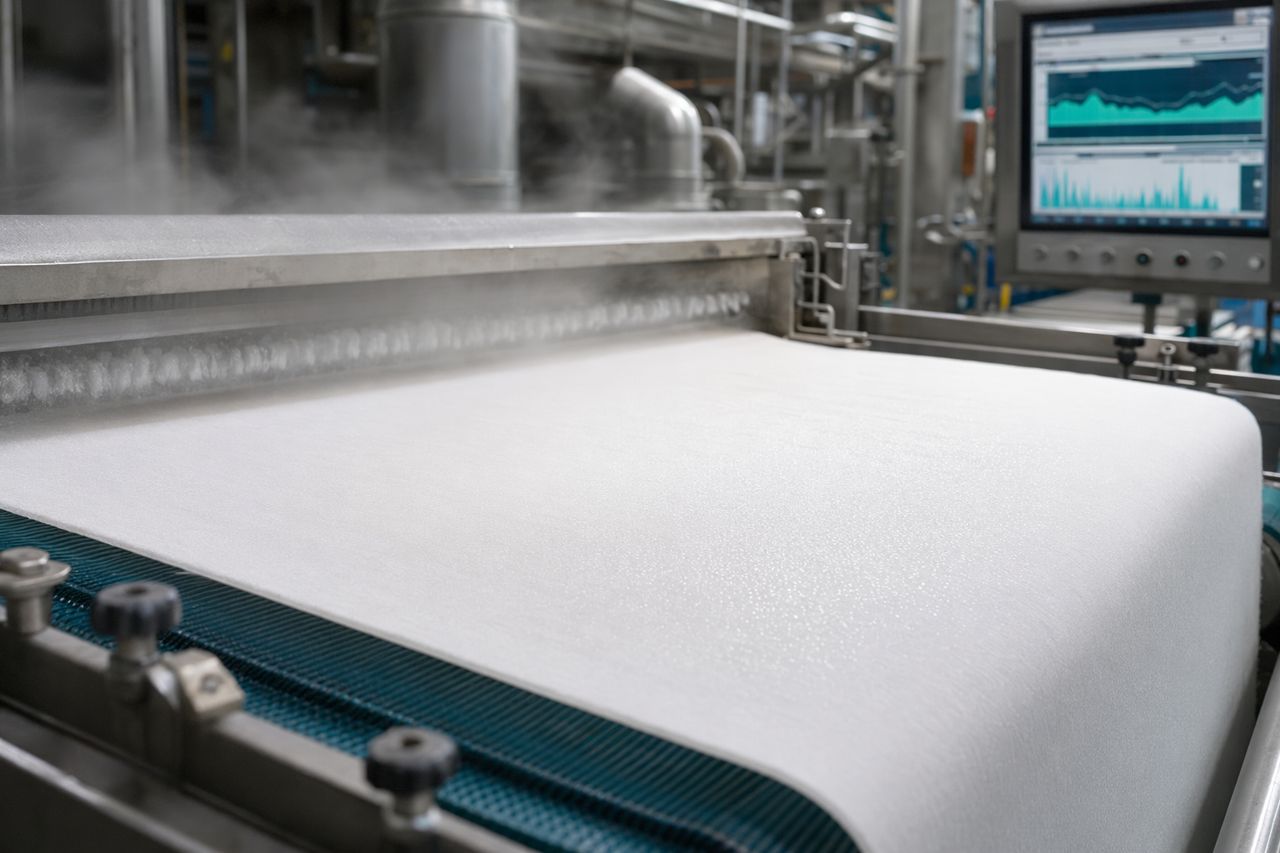
- More stable brightness development
- Lower visible dirt and speck load
- Reduced tacky deposit formation
- Cleaner screen operation and fewer plugging events
- Improved drainage and stock handling
- Lower dependence on aggressive chemical correction
- Reduced cleaning downtime
- Improved usable fiber yield through more selective removal
- More predictable performance during furnish changes
The right result is the one your line can measure in production.
Enzymes are not a substitute for good housekeeping
No enzyme program can overcome poor contaminant removal, uncontrolled furnish intake, overloaded screens, or unstable chemistry. The strongest results usually come when enzyme treatment is combined with disciplined mill operation:
- Keep pulper detrashing effective
- Avoid unnecessary adhesive fragmentation
- Track label-heavy sources separately when possible
- Maintain screen baskets and cleaners
- Monitor pH, temperature, conductivity, and charge trends
- Keep flotation chemistry aligned with furnish changes
- Control white water loop accumulation
- Record deposit locations and timing by furnish campaign
Enzyme treatment works best when it is integrated into this operating discipline.
Buyer’s checklist for an enzyme supplier
When evaluating an enzyme supplier for paper deinking mills, ask practical questions:
- Do they understand recovered fiber contaminants beyond ink?
- Can they discuss stickies, labels, hot-melt adhesives, and tape in mill terms?
- Will they review your process window before recommending a product?
- Can the program fit your existing pulper, deinking, or thick-stock layout?
- Do they focus on production outcomes such as brightness, drainage, downtime, and chemical reduction?
- Can they support a controlled mill trial with clear success criteria?
- Do they avoid one-size-fits-all claims?
Pulprift is built for that conversation.
Request a quote for a recovered fiber enzyme program
If stickies, labels, tape, or hot-melt adhesives are limiting your deinking line, Pulprift can help evaluate the right treatment window for your furnish and process layout.
Prepare the basics if available:
- Recovered paper grade mix
- Pulper temperature and retention time
- pH range through pulping and flotation
- Main deposit locations
- Brightness target and current gap
- Screening or flotation bottlenecks
- Current chemical program and reduction goals
Request a quote using the on-site form and include the operating problem you want to solve. Pulprift will respond with a practical recommendation for your mill conditions.